











How to Choose the Right Kitchen Chimney

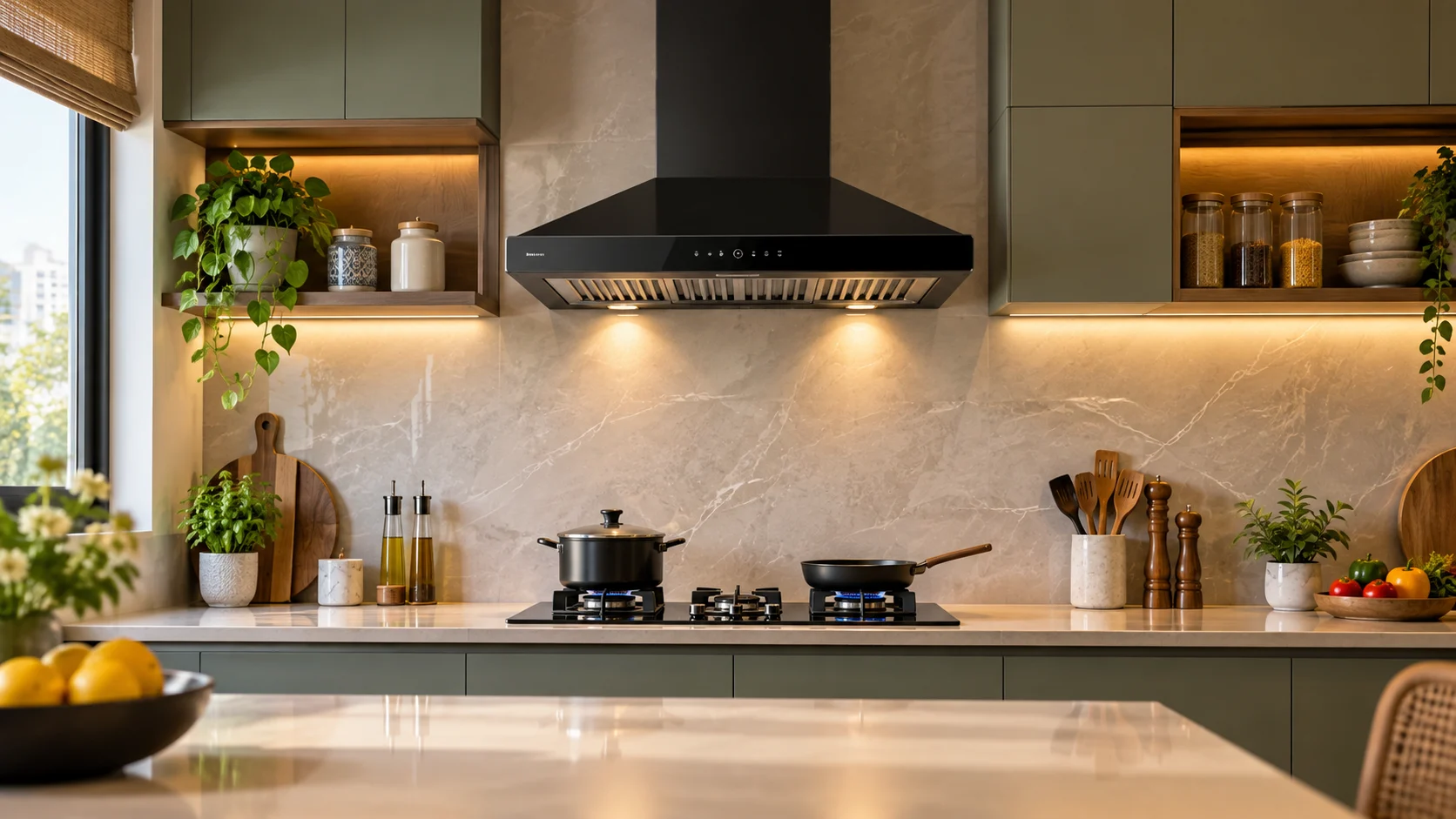
Choosing the right kitchen chimney can make your kitchen cleaner, more comfortable and easier to maintain.
A kitchen chimney is more than just a stylish appliance. It helps remove smoke, oil particles, steam and cooking odours before they spread through your kitchen and home.
For Indian kitchens, where frying, tadka and spice-heavy cooking are common, choosing the right chimney can make a noticeable difference to cleanliness and comfort.
But with different sizes, suction capacities, filter technologies and designs available, deciding which chimney to buy can be confusing.
Here is a simple way to choose the right one.
1. Start With the Size of Your Hob or Gas Stove
The width of the chimney should generally be equal to or slightly wider than your cooking area.
For most homes:
- 60 cm chimney: suitable for compact cooktops and many 2–4 burner gas stoves.
- 75 cm chimney: useful when you want slightly wider smoke coverage.
- 90 cm chimney: generally better for wider hobs, larger gas stoves and heavy cooking.
- 120 cm chimney: usually intended for extra-wide premium cooking setups.
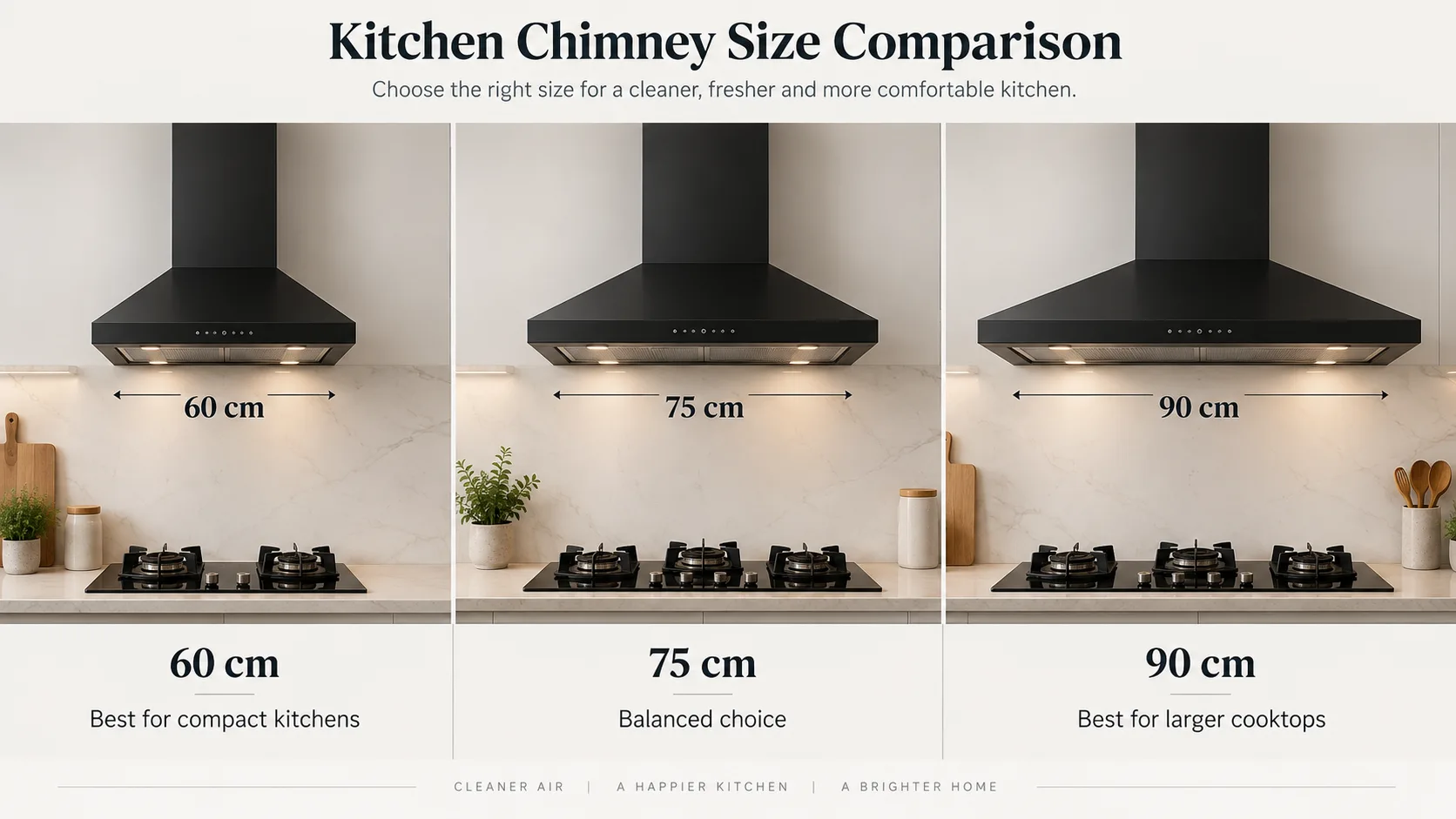
For example, if your hob is approximately 60 cm wide, a 60 cm chimney may be sufficient. If you use a wider 75–90 cm hob, choosing a 90 cm chimney usually provides better coverage.
You can browse our Kitchen Chimneys and compare sizes before selecting a model.
2. Choose Suction Power According to Your Cooking Style
Suction power tells you how much air the chimney can move and is usually measured in cubic metres per hour, or m³/hr.
If your cooking mainly involves boiling, light sautéing and occasional frying, a moderate suction level may be enough.
For regular Indian cooking involving tadka, deep frying, grilling and strong spices, a higher suction capacity is generally more useful.
Many modern chimneys designed for Indian kitchens offer suction ratings around 1,200 m³/hr or higher.
However, a higher number alone does not automatically mean better performance. Duct length, bends in the duct, chimney installation and kitchen ventilation also affect actual suction.
3. Understand the Filter Type
The filter is one of the most important parts of a chimney.
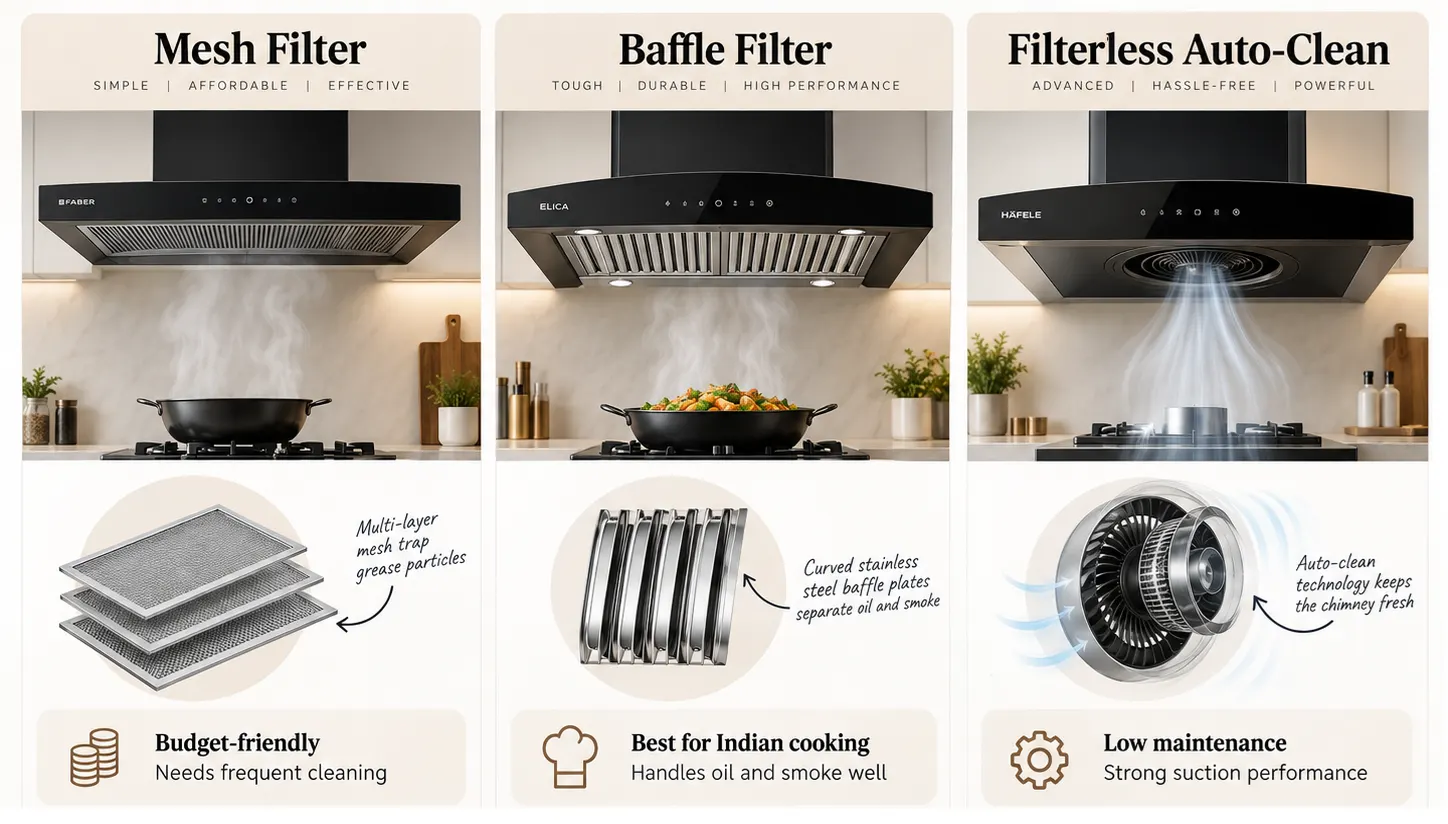
Baffle Filter
Baffle filters are widely used in Indian kitchens. They use curved metal panels to separate grease from the air.
They are durable and suitable for oily cooking, although they need periodic cleaning.
Filterless Chimney
Filterless chimneys use internal airflow technology without a traditional grease filter.
They usually require less routine filter cleaning and are becoming increasingly popular in modern kitchens.
Mesh Filter
Mesh filters use multiple layers of metal mesh to trap grease.
They can work well but may need more frequent cleaning, especially in kitchens where frying is common.
For most buyers today, baffle or filterless chimneys are usually easier choices for regular Indian cooking.
4. Ducted vs Recirculating Chimney
A ducted chimney sends smoke, heat and odours outside your home through a duct pipe.
This is generally the preferred setup when proper ducting is possible because the contaminated air is actually removed from the kitchen.
A recirculating chimney filters the air and sends it back into the kitchen. It can be useful where external ducting is difficult, but it may not remove heat and cooking odours as effectively as a properly installed ducted system.
If your kitchen allows it, consider planning the duct route before purchasing the chimney.
5. Keep the Duct Route as Simple as Possible
Chimney performance is affected by the installation.
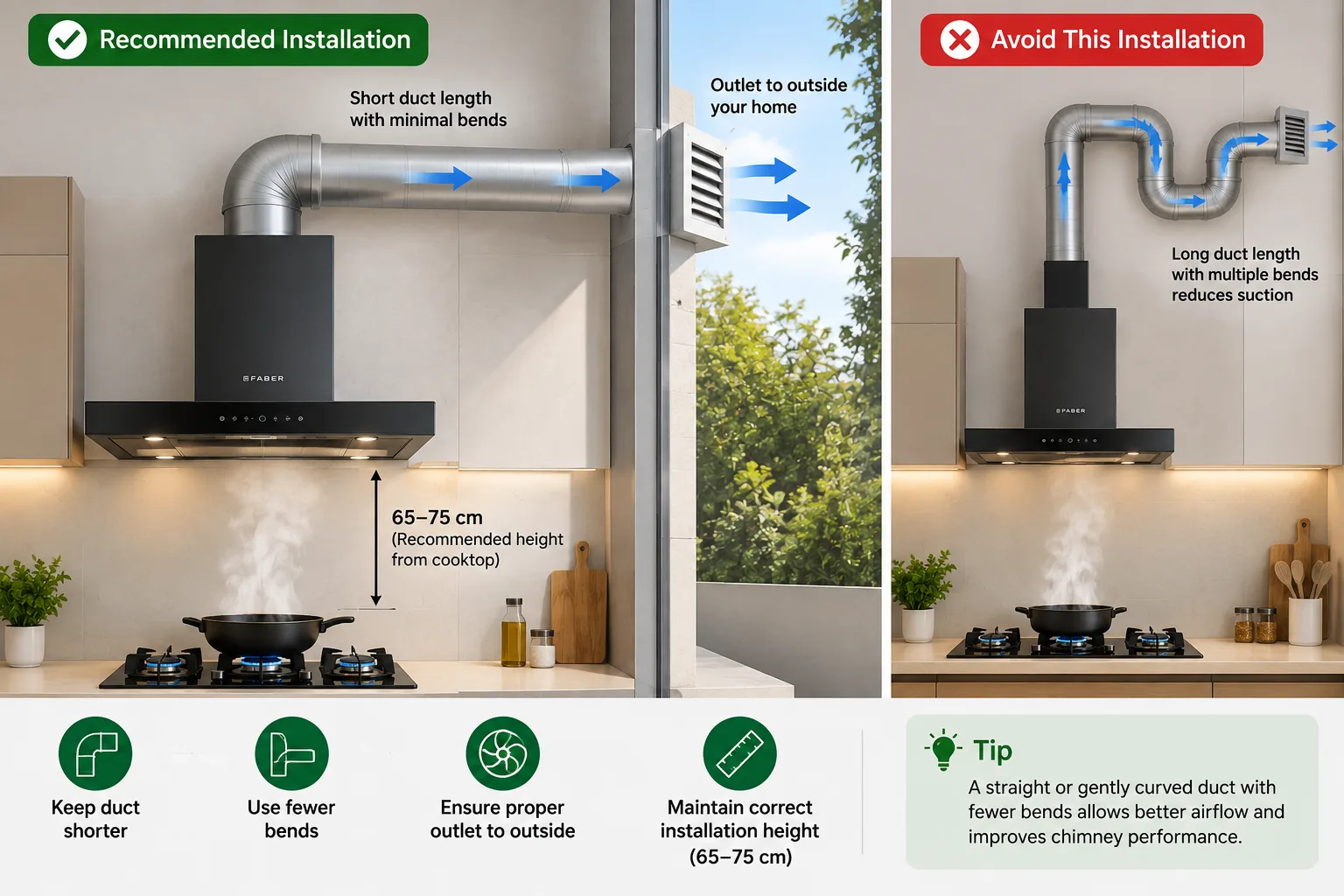
A shorter duct with fewer sharp bends generally allows better airflow.
Long ducts and multiple 90-degree bends create resistance and can reduce effective suction.
Before buying, check:
- Where the chimney will be installed
- Where the duct outlet will exit
- Approximate duct length
- Number of bends required
- Whether additional civil or carpentry work is needed
This is especially important in modular kitchens where cabinets are already installed.
6. Check Installation Height
A chimney should not be installed too close to or too far above the cooking surface.
Many installations fall roughly around 65–75 cm above the cooktop, but the correct distance depends on the chimney model, cooktop type and manufacturer’s instructions.
Always follow the installation specifications provided by the brand.
Incorrect mounting height can reduce suction performance and may also create safety concerns.
7. Consider Noise Levels
All chimneys produce some noise because they use a motor and fan to move large amounts of air.
Higher suction speeds usually create more sound.
When comparing models, don’t look only at maximum suction. Consider whether the chimney provides multiple speed settings so you can use lower speeds for normal cooking and higher speeds only when required.
8. Look for Useful Features
Modern kitchen chimneys may include features such as touch controls, gesture control, auto-clean technology, LED lighting and multiple fan speeds.
Auto-clean can help reduce grease accumulation inside the chimney.
Gesture control allows you to change settings by moving your hand near the control panel, which can be convenient while cooking.
LED lights provide additional illumination over your hob or gas stove.
These features are useful, but chimney size, suction performance and correct installation should remain your first priorities.
9. Choose a Design That Matches Your Kitchen
Chimneys are available in several styles, including wall-mounted, inclined, T-shaped and island designs.
Inclined black-glass chimneys work particularly well in contemporary kitchens, while traditional straight or T-shaped designs can provide a clean and professional appearance.
Choose the design after confirming that it is compatible with the layout of your cooktop and cabinets.
Which Kitchen Chimney Should You Choose? How to Choose the Right Kitchen Chimney for Your Cooking Style
For a typical Indian home, start by matching the chimney width with your cooktop and then evaluate your cooking habits.
A compact kitchen with moderate cooking may work well with a 60 cm chimney, while households using wider cooktops or doing frequent frying may prefer a 90 cm model with higher suction power.
If reducing maintenance is important, consider a filterless or auto-clean model.
The most important thing is to choose a chimney that fits your cooking area and can be installed correctly.
Frequently Asked Questions
Is a 60 cm chimney enough for a 4-burner stove?
It can be, provided the stove fits comfortably within the chimney’s coverage area. For a wider 4-burner stove, a 90 cm chimney may provide better smoke capture.
Is higher suction always better?
Not necessarily. Higher suction is useful for heavy cooking, but installation quality, duct length and duct bends also affect chimney performance.
Which chimney filter is best for Indian cooking?
Baffle filters have traditionally been popular for oily Indian cooking, while filterless chimneys are increasingly preferred by buyers looking for lower maintenance.
Is an auto-clean chimney worth buying?
It can reduce manual maintenance by helping collect grease inside the chimney, although periodic cleaning and servicing are still necessary.
Should the chimney be wider than the hob?
Ideally, the chimney should cover the cooking area properly. Choosing a chimney equal to or wider than the hob generally helps capture smoke more effectively.
To choose the right kitchen chimney, focus first on size, suction performance, ducting and installation requirements.
For brand-specific installation guidance, you can also refer to Faber India’s kitchen chimney installation guide.
Faber India chimney installation guide
Still Need Help Choosing the Right Chimney?
Not sure which chimney size, suction capacity or filter type is right for your kitchen? OneKitchen can help you choose a suitable model based on your cooktop size, cooking habits and installation requirements.
Browse our Kitchen Chimneys or Contact Us if you have any questions before placing your order.
Email: cs@onekitchen.in