











Hob vs Gas Stove: Which Is Better for Your Kitchen?

Hob vs Gas Stove: Which Is Better for Your Kitchen?
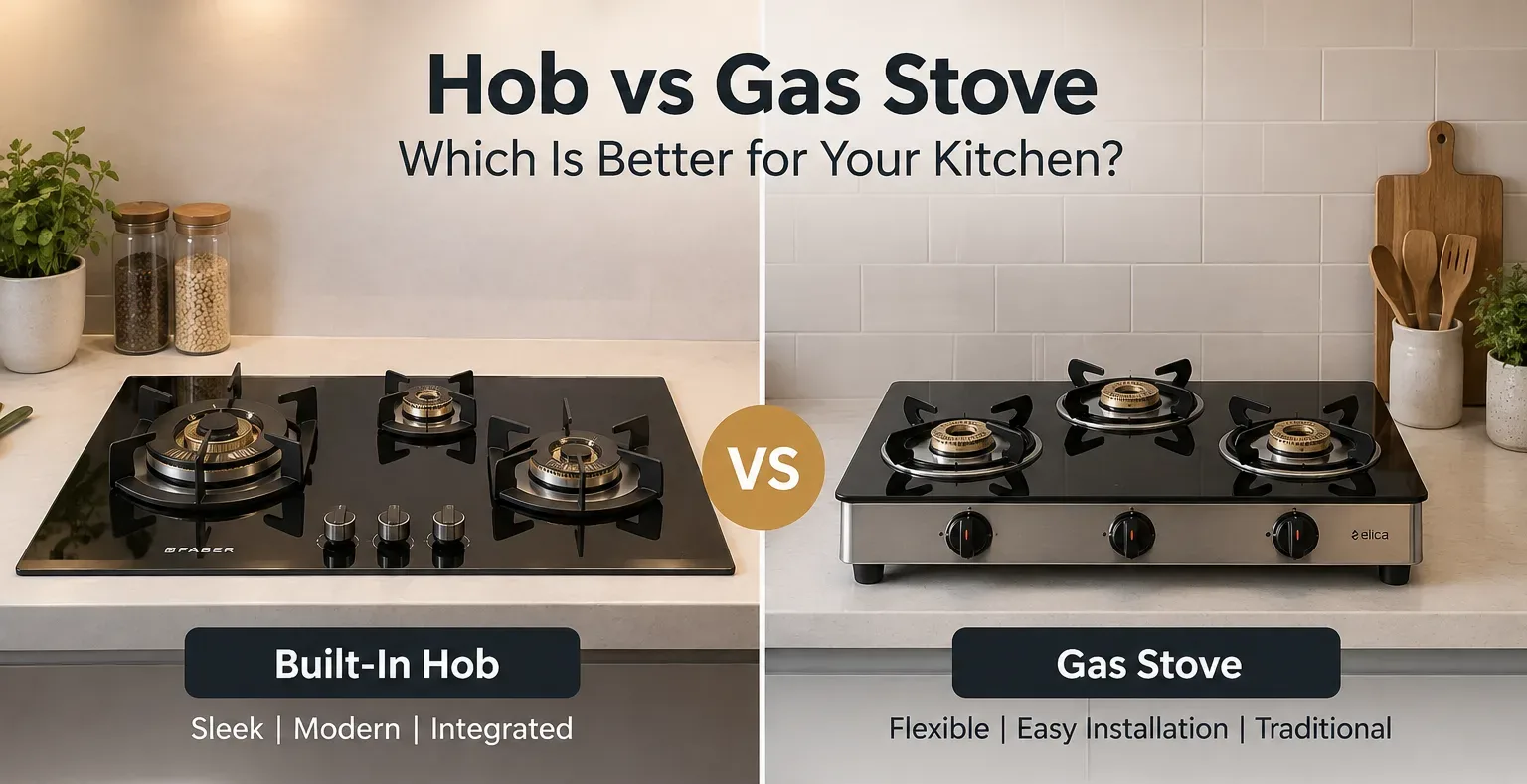
When setting up or renovating a kitchen, one common question is whether to choose a built-in hob or a traditional gas stove.
Both can handle everyday Indian cooking, but they differ significantly in installation, appearance, maintenance and flexibility.
The right choice depends less on which one is “better” and more on how your kitchen is designed and how you prefer to cook.
Here is a practical hob vs gas stove comparison to help you decide.
What Is a Built-In Hob?
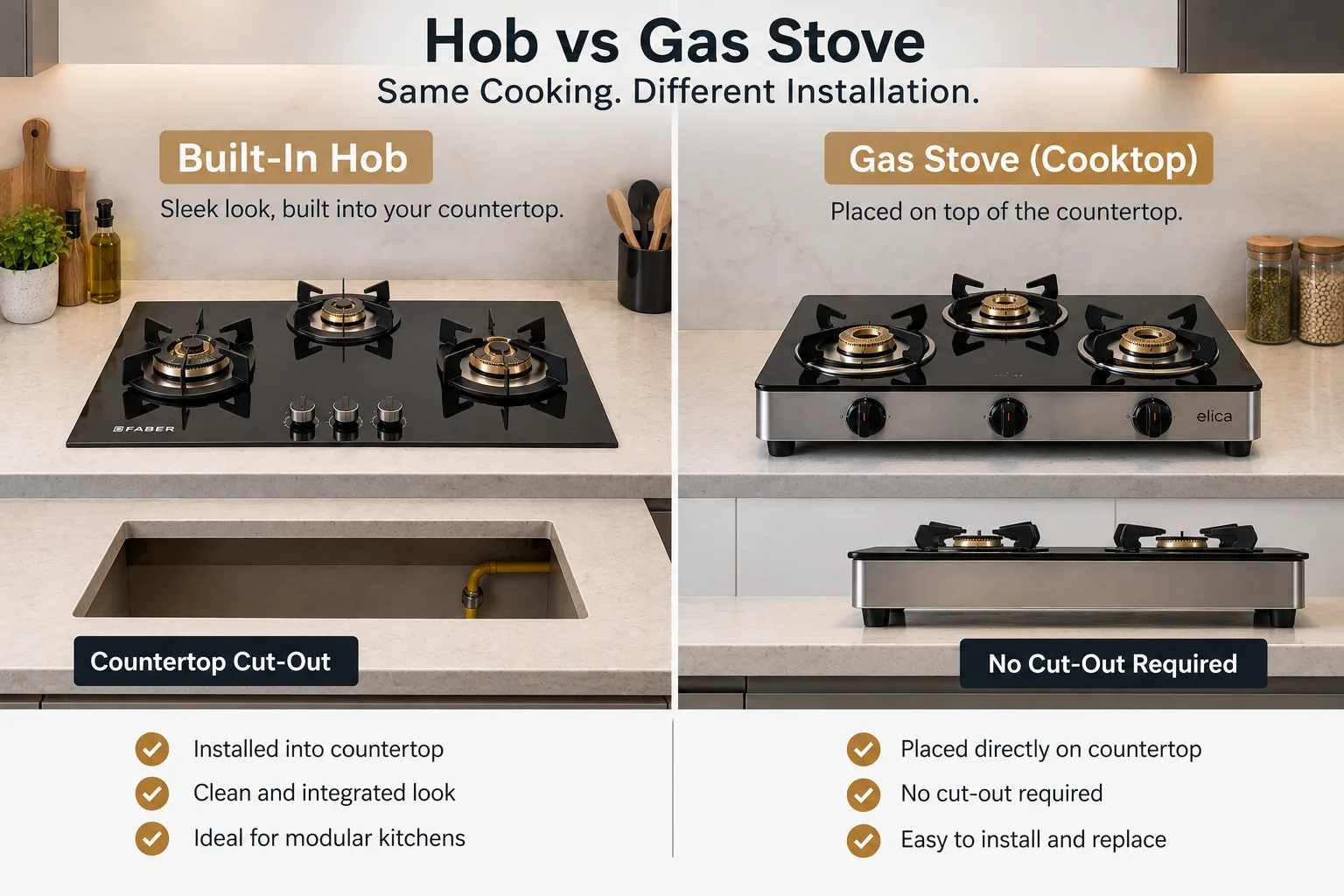
A built-in hob is installed directly into a cut-out in your kitchen countertop.
Only the cooking surface remains visible, giving the kitchen a clean and integrated appearance.
Modern hobs are available with different burner configurations and may include features such as:
- Auto ignition
- Flame failure safety
- Brass burners
- Cast-iron pan supports
- Glass surfaces
- Multiple burner sizes
Browse our Hobs to see different configurations.
What Is a Gas Stove?
A gas stove, also called a cooktop in many homes, is a freestanding appliance placed directly on top of the kitchen counter.
It connects to the gas supply without requiring a permanent cut-out in the countertop.
Gas stoves are available in:
- 2-burner
- 3-burner
- 4-burner
- Larger configurations
You can explore Gas Stoves & Cooktops at OneKitchen.
Hob vs Gas Stove: Quick Comparison
| Feature | Built-In Hob | Gas Stove |
|---|---|---|
| Installation | Built into countertop | Placed on countertop |
| Appearance | Sleek and integrated | Traditional/freestanding |
| Portability | Low | High |
| Counter modification | Required | Not required |
| Cleaning around appliance | Cleaner integrated look | Appliance can usually be lifted |
| Kitchen style | Modern/modular | Suitable for almost any kitchen |
| Replacement | Requires size compatibility | Generally easier |
| Initial setup | More involved | Simpler |
1. Kitchen Appearance
One of the biggest advantages of a built-in hob is its appearance.
Because the appliance sits almost flush with the countertop, it creates a seamless and premium look.
For newly designed modular kitchens, a hob often integrates very naturally with the cabinetry and countertop.
A gas stove remains visible above the counter, so the appearance is more traditional.
If aesthetics are a major priority, a hob may fit better with a modern kitchen design.
2. Installation
Installation is one of the biggest differences in the hob vs gas stove decision.
Built-In Hob
A hob requires an accurately sized countertop cut-out.
You should check:
- Hob dimensions
- Cut-out dimensions
- Countertop material
- Space below the hob
- Gas-line location
- Manufacturer installation requirements
Once installed, moving the hob is not as simple as moving a regular stove.
Gas Stove
A gas stove is considerably simpler.
Place it on a stable countertop, connect the approved gas line and follow the manufacturer’s installation instructions.
This makes it especially convenient for rented homes or kitchens where you do not want to modify the countertop.
3. Cleaning
Both appliances can be easy to clean, but in different ways.
A built-in hob creates fewer visible gaps between the appliance and countertop, which can make the overall kitchen surface look cleaner.
However, spilled food around burners and pan supports still needs regular cleaning.
With a gas stove, you can often clean underneath and around the appliance more easily because it is not permanently installed into the counter.
For either option, glass-top models should be cleaned using products and methods recommended by the manufacturer.
4. Burner Configuration
Both hobs and gas stoves are available with multiple burner configurations.
When selecting one, think about how many vessels you normally use simultaneously.
2 Burners
Suitable for smaller households or kitchens with limited counter space.
3 Burners
Provides a useful balance between size and cooking flexibility.
4 Burners
Better suited to households that frequently prepare several dishes at the same time.
Some premium hobs offer larger burner layouts designed for bigger cookware and different cooking intensities.
5. Cooking Style
For normal Indian cooking, both hobs and gas stoves can perform very well.
Instead of choosing purely by product type, check the actual burner specifications.
Consider:
- Burner size
- Flame distribution
- Burner material
- Pan-support stability
- Distance between burners
- Compatibility with large kadais and pressure cookers
If you frequently use several large utensils simultaneously, burner spacing can be just as important as the number of burners.
6. Safety Features
Some modern hobs offer flame failure devices.
If the flame goes out unexpectedly, this type of safety system is designed to stop the gas supply to that burner.
Safety features vary by model, so always check the specifications of the individual appliance rather than assuming every hob includes them.
Regardless of appliance type, installation and gas connections should follow the manufacturer’s recommendations.
7. Auto Ignition
Built-in hobs commonly offer integrated auto ignition.
Depending on the model, ignition may be battery-powered or electrically powered.
Many modern gas stoves also offer auto ignition, although manual ignition models remain widely available.
If convenience is important to you, check the ignition type before purchasing.
8. Kitchen Chimney Compatibility
Whether you choose a hob or gas stove, the cooking area should be properly covered by your kitchen chimney.
The chimney should generally be at least as wide as the cooking appliance.
For example:
- Compact cooktop → commonly paired with a 60 cm chimney
- Wider cooktop → often better suited to a 75 cm or 90 cm chimney
Read our guide to choosing the right kitchen chimney for more information about chimney size and suction.
You can also browse Kitchen Chimneys.
9. Flexibility and Replacement
A gas stove has a clear advantage when it comes to flexibility.
You can replace it relatively easily with another model without modifying your countertop.
A built-in hob needs to fit the existing cut-out.
If you later change to a hob with substantially different dimensions, countertop modification may be required.
This is worth considering before making the cut-out during a new kitchen installation.
10. Which Is Better for a Rented Home?
For most rented homes, a freestanding gas stove is usually the simpler option.
It does not normally require permanent countertop modification and can be taken with you when you move.
A built-in hob makes more sense when you own the kitchen or have permission to make permanent alterations.
11. Which Is Better for a Modular Kitchen?
A built-in hob is particularly well suited to modular kitchens because of its integrated appearance.
If you are designing the kitchen from scratch, you can plan the:
- Hob cut-out
- Gas connection
- Chimney position
- Cabinet layout
- Electrical point for auto ignition
at the same time.
This produces a much cleaner installation.
Hob vs Gas Stove: Which Should You Choose?
Choose a built-in hob if you value:
- Integrated appearance
- Modern modular-kitchen design
- Built-in installation
- Premium features
- A clean countertop layout
Choose a gas stove if you value:
- Simple installation
- Easy replacement
- Portability
- No permanent countertop cut-out
- Flexibility for rented accommodation
Neither option is automatically better for every kitchen.
The best choice depends on your kitchen layout, budget, cooking habits and whether you want a permanent built-in installation.
Frequently Asked Questions
Is a hob better than a gas stove?
Not necessarily. A hob offers an integrated appearance and built-in installation, while a gas stove provides greater portability and simpler replacement.
Can a hob be used for Indian cooking?
Yes. Many hobs are designed for everyday Indian cooking. Check burner spacing, burner power and cookware compatibility when choosing a model.
Can I replace a gas stove with a hob?
Yes, but the countertop normally needs an appropriate cut-out, and the gas connection and installation area must meet the manufacturer’s requirements.
Is a 3-burner or 4-burner hob better?
That depends on how many dishes you normally cook simultaneously and the amount of countertop space available. Burner spacing should also be considered.
Do I need a chimney above a hob?
A chimney is not part of the hob itself, but it can significantly help manage smoke, grease and cooking odours. Proper chimney sizing and installation are important for effective extraction.
Still Not Sure Which One to Choose?
Choosing between a hob and gas stove can depend on your countertop, kitchen design, cooking habits and installation requirements.
Browse our Hobs and Gas Stoves & Cooktops to compare options.
If you still have questions before purchasing, Contact OneKitchen and we’ll help you understand which option may suit your kitchen.
Email: cs@onekitchen.in