











Built-In Oven vs OTG: Which Is Better for Kitchen?

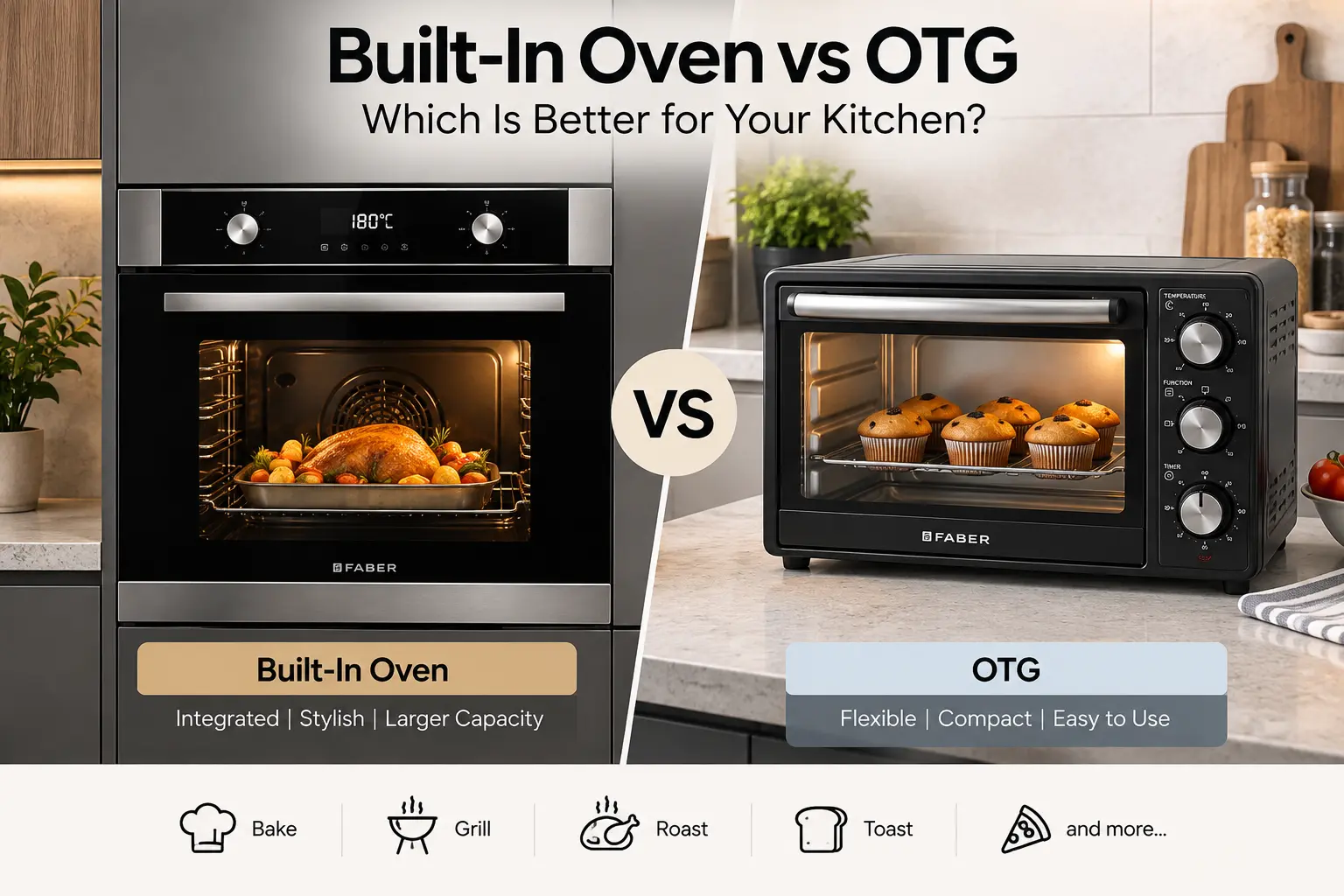
Built-In Oven vs OTG: Which Is Better for Your Kitchen?
If you enjoy baking, grilling or roasting, you may eventually face a common question: should you buy a built-in oven or an OTG?
Both appliances can bake cakes, roast vegetables, grill food and prepare a wide range of dishes, but they are designed for very different kitchen setups.
A built-in oven becomes part of your modular kitchen, while an OTG — Oven, Toaster and Griller — is usually a countertop appliance that can be moved or replaced more easily.
This built-in oven vs OTG guide explains the important differences so you can decide which option better suits your kitchen, cooking habits and available space.
What Is a Built-In Oven?
A built-in oven is installed directly inside a kitchen cabinet or tall appliance unit.
Unlike a countertop oven, it does not sit on your worktop. The cabinetry is designed around the oven so that the appliance becomes part of the kitchen layout.
Built-in ovens are commonly chosen for modern modular kitchens where appliance placement can be planned during the design stage.
You can explore our Built-In Appliances for compatible kitchen solutions.
What Is an OTG?
An OTG stands for Oven, Toaster and Griller.
It is generally a countertop appliance with heating elements at the top and bottom of the cavity.
Depending on the model, an OTG may be used for baking, grilling, roasting, toasting and reheating certain foods.
Because it does not normally require permanent cabinetry installation, an OTG can be a practical choice for smaller kitchens, rented homes or buyers who want a relatively simple setup.
Built-In Oven vs OTG: Quick Comparison
| Feature | Built-In Oven | OTG |
|---|---|---|
| Installation | Installed inside cabinetry | Placed on countertop |
| Kitchen space | Does not occupy worktop | Requires counter space |
| Appearance | Integrated and premium | Standalone appliance |
| Portability | Low | High |
| Capacity | Often larger | Usually compact to medium |
| Temperature control | Generally more sophisticated | Depends on model |
| Cooking programs | Often more extensive | Usually simpler |
| Installation planning | Required | Minimal |
| Replacement | Must fit cabinet opening | Generally easier |
| Best suited for | Modular kitchens and frequent oven use | Flexible countertop cooking |
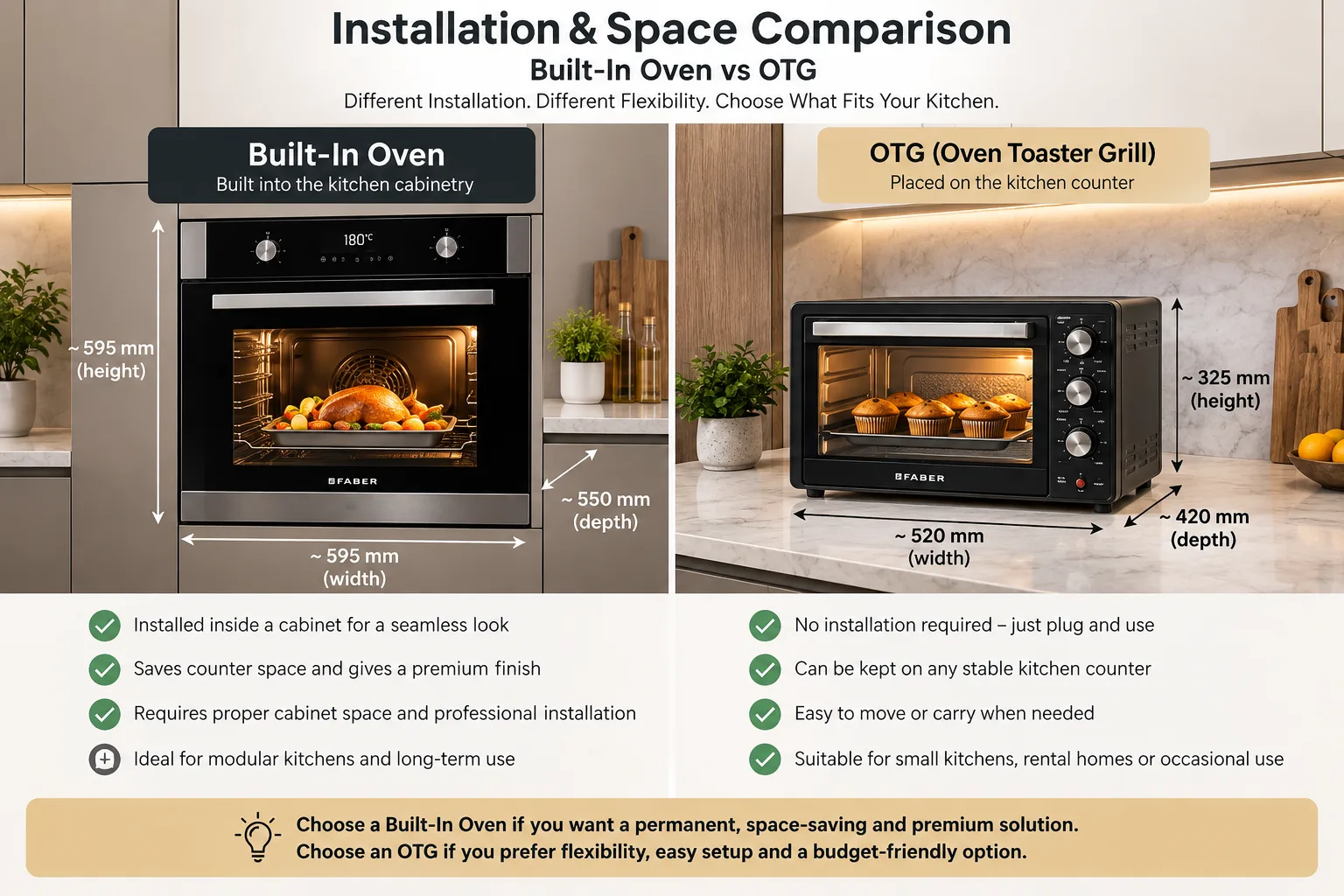
1. Installation
Installation is one of the biggest differences in the built-in oven vs OTG decision.
A built-in oven requires dedicated cabinet space.
The kitchen designer or installer should consider the oven’s:
- external dimensions
- cabinet cut-out dimensions
- ventilation requirements
- electrical requirements
- clearance around the appliance
An OTG is considerably simpler to position. You normally need a stable countertop, appropriate clearance around the appliance and a suitable electrical outlet.
Always follow the manufacturer’s installation and ventilation instructions for either appliance.
2. Kitchen Space
A built-in oven can be particularly useful when you want to preserve countertop space.
Because the oven is installed within cabinetry, your worktop remains available for food preparation and other small appliances.
An OTG occupies countertop space.
This may not matter in a large kitchen, but in a compact kitchen the appliance can take up a noticeable amount of useful workspace.
However, an OTG can usually be moved when necessary, while a built-in oven becomes a permanent part of the kitchen.
3. Capacity
Built-in ovens are often selected by households that need more cooking capacity or expect to use the oven frequently.
A larger cavity can make it easier to prepare bigger dishes, use larger baking trays or cook several portions at once.
OTGs are available in many capacities, from compact models to relatively large countertop units.
Before buying either appliance, consider what you actually intend to cook.
For example, someone mainly making toast, small cakes and occasional grilled dishes may not need the same capacity as a household regularly baking large batches or roasting food for several people.
4. Baking Performance
Both appliances can be used for baking, but their heating systems may differ.
Many built-in ovens include features designed to distribute heat more evenly throughout the cavity.
Depending on the model, these may include convection fans, multiple heating modes and electronic temperature control.
OTGs generally use heating elements positioned at the top and bottom.
Some models also include convection fans.
For regular home baking, either can work well when used correctly, but users who bake frequently may appreciate the additional cooking modes and temperature control available in many built-in ovens.
5. Grilling and Roasting
Both built-in ovens and OTGs can be used for grilling and roasting.
The important differences are usually cavity size, available heating modes and accessories.
When comparing built-in oven vs OTG, check whether the appliance includes or supports:
- grill racks
- baking trays
- rotisserie accessories
- convection
- multiple rack positions
- top and bottom heating combinations
The feature set varies significantly between individual models.
6. Temperature Control
Temperature stability can be particularly important for baking.
Many modern built-in ovens use electronic controls and thermostats designed for precise temperature management.
OTGs may use mechanical knobs or digital controls depending on the model.
A quality OTG can still perform very well, but buyers who regularly prepare temperature-sensitive recipes may want to pay closer attention to temperature-control features.
7. Cooking Programs
Built-in ovens often provide more automatic or predefined cooking functions.
Depending on the model, these might include convection baking, grilling, defrosting, pizza modes or combinations of different heating elements.
An OTG normally offers a simpler set of functions controlled through temperature, heating-mode and timer settings.
This simplicity can actually be an advantage for buyers who do not need many automated functions.
8. Preheating
Both appliance types may require preheating for certain recipes.
Preheating allows the cooking chamber to reach the required temperature before food is placed inside.
The actual preheating time varies according to appliance size, heating system and selected temperature.
A smaller OTG may heat relatively quickly because of its smaller cavity, while larger ovens may take longer depending on their design.
9. Power Requirements
Before purchasing either appliance, check its electrical requirements.
Higher-capacity ovens may require dedicated electrical circuits or specific sockets according to the manufacturer’s instructions.
A built-in oven should have its electrical supply planned during installation.
An OTG is generally easier to connect, but the electrical point still needs to meet the appliance’s power requirements.
Avoid using unsuitable extension boards or adapters with high-power kitchen appliances.
10. Cleaning
Both appliances require regular cleaning.
Built-in ovens may offer features such as removable door glass, enamelled interiors or specialised cleaning programs depending on the model.
An OTG generally has a simpler cavity and removable trays or racks that can be cleaned separately.
Spills are easier to remove when cleaned promptly rather than after repeated heating cycles.
Always allow the appliance to cool before cleaning and follow the manufacturer’s instructions.
11. Appearance
For a premium modular kitchen, a built-in oven usually provides the more integrated appearance.
It can be installed at a convenient height inside a tall cabinet and paired visually with other Built-In Appliances.
An OTG remains visible on the countertop.
That does not necessarily look bad, particularly with modern black or stainless-steel models, but it does not provide the same integrated appearance as a built-in appliance.
12. Flexibility
An OTG has a major advantage when it comes to flexibility.
It can usually be moved, replaced or taken with you if you change homes.
A built-in oven is designed for a particular cabinet opening.
If you later replace it, the new oven needs to be compatible with the existing cabinet dimensions or the cabinetry may need modification.
13. Which Is Better for a Rented Home?
For most rented homes, an OTG is usually the easier option.
It does not normally require permanent cabinet alterations and can move with you.
A built-in oven makes more sense where the kitchen is designed around permanent integrated appliances.
14. Which Is Better for a Modular Kitchen?
A built-in oven works particularly well in a new modular kitchen.
You can plan the oven, hob, chimney, cabinetry and electrical connections together.
This creates a more coordinated kitchen layout and can keep frequently used appliances at convenient working heights.
For a complete setup, you can also explore our Hobs and Kitchen Chimneys.
15. Which Option Is More Practical for Occasional Baking?
If you bake or grill only occasionally, an OTG may provide all the functionality you actually need without requiring permanent installation.
It can also be a useful choice when you want an additional oven without redesigning the kitchen.
For frequent baking, entertaining or more intensive oven use, the larger capacity and additional functions available in many built-in ovens may be more convenient.
Built-In Oven vs OTG: Which Should You Choose?
The best choice depends on how you use your kitchen.
Choose a built-in oven when you want an integrated modular-kitchen appearance, more permanent installation, larger cooking capacity or more sophisticated cooking functions.
Choose an OTG when you want flexibility, easier installation, countertop convenience and an appliance that can be moved or replaced easily.
The built-in oven vs OTG decision should ultimately be based on available kitchen space, cooking frequency, capacity requirements and installation plans rather than appearance alone.
Frequently Asked Questions
Is an OTG good for baking cakes?
Yes. OTGs are commonly used for baking cakes, cookies and other baked items. Results depend on the appliance, temperature settings, recipe and correct preheating.
Can an OTG replace a built-in oven?
For many everyday baking and grilling tasks, an OTG may be sufficient. However, capacity, temperature control and available cooking modes can differ from those of a built-in oven.
Does a built-in oven need special cabinetry?
Yes. Built-in ovens require cabinet space that meets the dimensions, ventilation and clearance specifications provided by the manufacturer.
Can I install a built-in oven under a hob?
Some kitchen layouts allow an oven beneath a hob, but compatibility, ventilation, clearances and installation requirements must be checked for the specific appliances.
Is an OTG suitable for a small kitchen?
It can be, provided sufficient countertop space and ventilation clearance are available.
Which is easier to replace?
An OTG is generally easier because it is a standalone appliance. A replacement built-in oven needs to fit the existing cabinetry or the cabinet may require modification.
Still Need Help Choosing?
Still unsure whether a built-in oven vs OTG is right for your kitchen?
Explore our Built-In Appliances and Small Appliances to compare your options.
If you have questions about dimensions, installation or choosing the right appliance, Contact OneKitchen before placing your order.
Email: cs@onekitchen.in